
Teaching & Learning Process
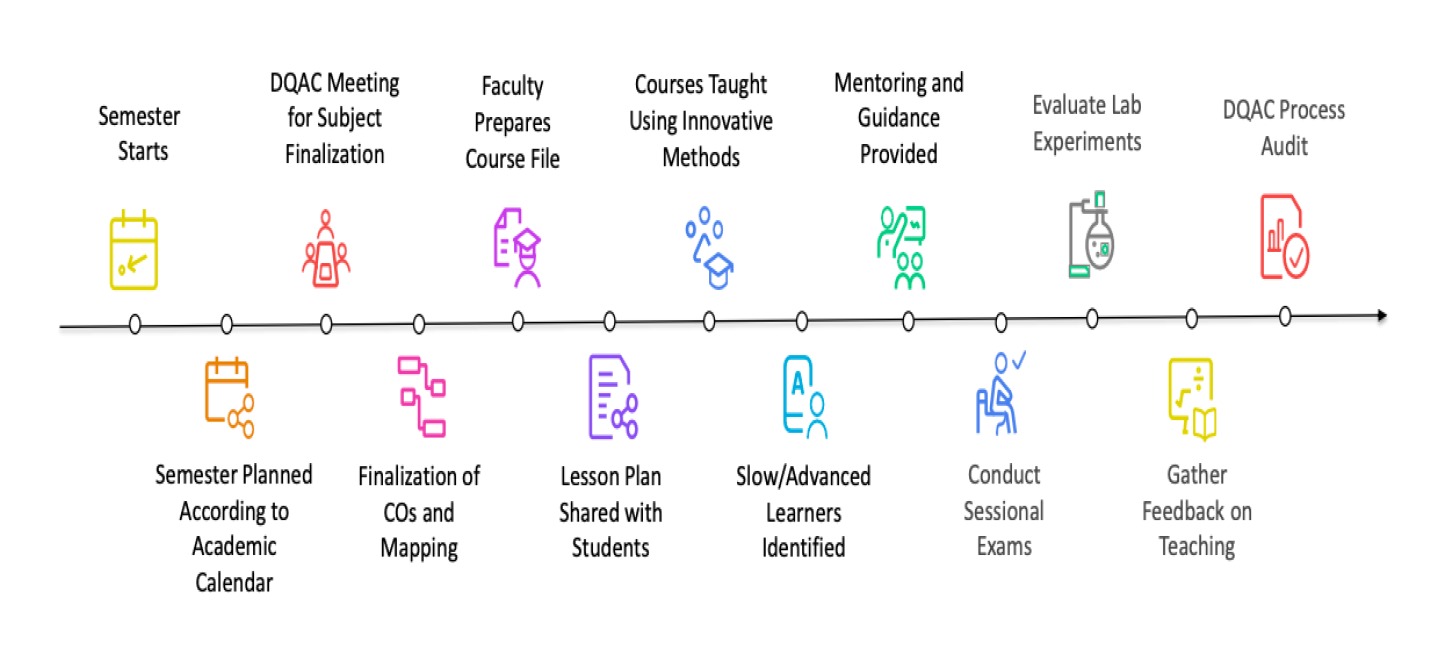
- The department follows an academic calendar aligned with I.P. University guidelines, which
includes a regular teaching plan, test schedules, and co-curricular and extracurricular activities to
enhance students' overall development.
- Subject allocation is completed well in advance, allowing faculty to accurately prepare course
outcomes and lesson plans before the semester begins, with approval from the DQAC.
- For open and departmental elective subjects, the department offers students are allowed to choose
the subject with majority preference is chosen.
- The lesson plan, along with the course outcomes, is shared with students, and lectures/tutorials are
conducted accordingly to ensure transparency in the teaching process
- Course outcomes (COs) for all subjects are framed using Bloom’s Taxonomy
action verbs. These COs are mapped to program outcomes (POs) and program-specific outcomes
(PSOs). The CO and PO targets are set based on the previous year's attainments, followed by
discussions between the faculty and DQAC, leading to the formulation of an action plan.
- Co-curricular and extracurricular activities are planned to address identified gaps.
- Course files for all subjects are prepared based on a DQAC-provided checklist, which includes the
syllabus, lesson plan, previous year’s university question papers, assignments, tutorial problems,
and solutions to test questions.
- Innovative teaching methods are used to enhance lecture delivery, including PowerPoint
presentations, video lectures, flipped classrooms and student presentations.
- Laboratory experiments are conducted following university guidelines, with detailed lab manuals
available to instructors for explaining experiments during lab sessions. Lab evaluation sheets and
attendance records are meticulously maintained.
- Tutorials and assignments are conducted by faculty as per the lesson plan, allowing students to
practice and address any problems with the subject teacher. This helps to assess students’
understanding and clarify any doubts.
- Sessional test and lab viva are scheduled as per the academic calendar and evaluated accordingly.
- Slow/ Advance learners are identified on the bases of test and faculty feedback, Students who do
not achieve the required marks or not actively participating in class are categorized as slow learners
and are encouraged to attend revision classes, with extra attention given by the subject faculty.
- The department allows students to show their answer sheets of sessional tests, helping them
understand their mistakes and improve their writing for future exams.
Enquire Now
