 Delhi is a popular destination for students looking to pursue a B.Tech degree. The city and its surrounding NCR region offer access to established universities, engineering institutes, technology-focused campuses, and a broad professional ecosystem.
For students searching for B.Tech colleges in Delhi, the choice should go beyond college popularity. Course options, practical learning, laboratories, faculty, projects, industry exposure, campus environment, admission requirements, and career support are all important factors to consider.
Why Pursue B.Tech in Delhi?
A B.Tech degree provides students with a foundation in engineering, technology, mathematics, problem-solving, and technical applications. Delhi’s location within the NCR also gives students access to a wider professional ecosystem covering technology, manufacturing, consulting, services, startups, and other industries.
Students can choose from different engineering disciplines depending on their interests, including Computer Science and Engineering, Electronics and Communication Engineering, Mechanical Engineering, Civil Engineering, and emerging technology-oriented fields.
B.Tech Colleges in Delhi
Students researching B.Tech colleges in Delhi will find institutions with different academic structures and specializations. Instead of treating a general list as a definitive ranking, students should compare colleges according to their own academic interests and career objectives.
Echelon Institute of Technology, Faridabad
Echelon Institute of Technology, Faridabad is located in Faridabad, within the wider Delhi NCR region, and can be considered by students whose search for B.Tech education extends beyond Delhi’s administrative boundaries.
The institute provides an academic environment that combines classroom learning with practical exposure, laboratory activities, projects, and technology-oriented learning. Students can use these opportunities to develop technical understanding and application-oriented skills.
Its location also allows students to remain connected to the wider Delhi NCR educational and professional ecosystem while studying in Faridabad.
B.Tech Specializations to Explore
One of the first decisions students need to make is the engineering specialization they want to pursue. Computer Science and Engineering is suitable for students interested in programming, software, computing, and digital technologies.
Students interested in newer technology areas can explore Artificial Intelligence and Machine Learning, where concepts related to intelligent systems, algorithms, data, and computational problem-solving become important.
Electronics and Communication Engineering can suit students interested in electronics, communication technologies, embedded systems, and related technical applications. Students interested in physical systems and industrial applications can explore disciplines such as Mechanical Engineering and Civil Engineering.
The appropriate specialization ultimately depends on a student’s interests, strengths, and long-term career plans.
Importance of Practical Learning in B.Tech
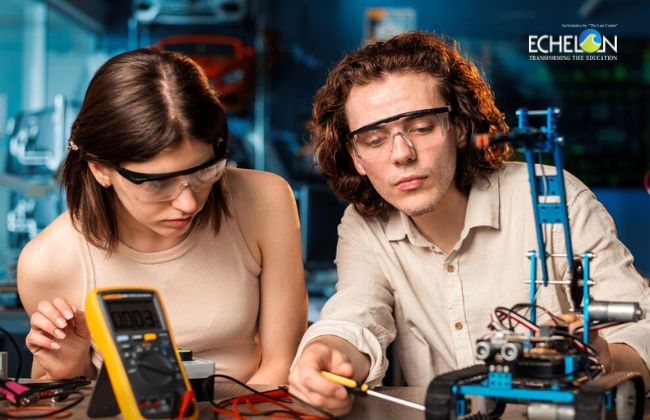
Engineering cannot be fully understood through textbooks alone. Laboratory sessions allow students to apply concepts, perform experiments, analyse results, and understand how theoretical principles work in practical situations.
Projects take practical learning a step further. Students may need to identify a problem, research possible solutions, design a system, implement it, test it, and make improvements.
For this reason, students searching for B.Tech colleges in Delhi should examine how much emphasis an institution places on hands-on learning and project development.
Advanced Laboratories and Technology Exposure
Modern engineering increasingly overlaps with emerging technologies. Students can benefit from exposure to areas such as AI, machine learning, data science, cybersecurity, cloud computing, IoT, networking, robotics, and automation.
Advanced laboratories can give students opportunities to experiment with technologies and apply their academic knowledge. However, the value of laboratory infrastructure depends not only on the facilities available but also on how actively students are encouraged and guided to use them.
Project-Based Learning
Project-based education can help students develop skills that extend beyond individual subjects. A single engineering project may require programming, research, design, testing, documentation, teamwork, and presentation.
These activities can strengthen technical knowledge while developing communication, analytical thinking, creativity, and problem-solving abilities.
Students can also use meaningful academic projects to demonstrate their skills when applying for internships or entry-level professional opportunities.
Industry Exposure and Career Development
Students should also consider how an institution supports the transition from academic education to professional life.
Internships, workshops, industry interactions, technical events, career training, communication development, and interview preparation can all contribute to career readiness. Students should begin building their skills early rather than waiting until their final semester.
A strong academic foundation combined with practical experience can help students better understand their chosen field and identify the career direction they want to pursue.
Why Consider the Delhi NCR Region?
Although students may specifically search for B.Tech colleges in Delhi, it is worth considering the wider NCR region as well. Faridabad, Noida, Ghaziabad, and Gurugram are geographically connected to Delhi and form part of the larger education and employment ecosystem.
Expanding the search to Delhi NCR can give students more options while allowing them to compare institutions based on academics, infrastructure, practical learning, specialization, fees, and career opportunities.
Why Consider EIT for B.Tech?
For students looking for B.Tech education in the wider Delhi NCR region, Echelon Institute of Technology, Faridabad offers a technology-focused academic environment.
Students can complement classroom learning with practical activities, laboratory work, projects, and exposure to emerging technologies. This approach can help them develop a stronger understanding of how engineering concepts are applied to real-world problems.
Students should review the latest course availability, eligibility criteria, admission process, fees, and institutional information before applying.
How to Choose the Right B.Tech College
There is no single factor that determines the right engineering college for every student. Before making a decision, students should evaluate the course and specialization, curriculum, practical facilities, faculty, laboratories, project opportunities, internships, industry exposure, campus environment, fees, and career support.
It is also important to verify current information from official sources because admission rules, program availability, and fees can change between academic sessions.
Building Skills Alongside the Degree
A B.Tech degree is the foundation of an engineering career, but students can make their education more valuable by developing additional skills.
Depending on their specialization, students can learn programming languages, technical software, data tools, design platforms, cloud technologies, electronics tools, or other relevant technologies. Communication, teamwork, analytical thinking, and problem-solving are equally important.
Participating in projects, internships, technical competitions, workshops, and independent learning can help students build a stronger professional profile.
Conclusion
Students searching for B.Tech colleges in Delhi should consider both Delhi-based institutions and suitable options across the wider NCR region. The right choice depends on the student’s preferred specialization, academic objectives, practical learning requirements, career plans, and budget.
Echelon Institute of Technology, Faridabad can be explored by students who want to pursue B.Tech education in the Delhi NCR region with an emphasis on academic foundations, practical exposure, projects, and technology-oriented learning.
Rather than choosing a college solely because it appears on a “top colleges” list, students should research the complete learning environment and select an institution that aligns with their interests, skills, and long-term career goals.
