
 Imagine a world where bridges design themselves for optimal strength, factories predict their own maintenance needs, and medical devices adapt to patients in real-time. This isn’t a scene from a sci-fi movie; it’s the rapidly approaching future of engineering, driven by the powerful trio of Artificial Intelligence (AI), Robotics, and Automation.
For aspiring engineers, this presents a thrilling question: how does one prepare for a career that is constantly being redefined by the very technologies they will use? The answer lies in an engineering education that is as dynamic and forward-thinking as the future it prepares students for. At Echelon Institute of Technology, Faridabad, we are not just watching this transformation—we are actively building the educational framework for it.
The Unstoppable Trifecta: More Than Just Buzzwords
Before we dive into the classroom, let’s understand the forces at play.
-
Artificial Intelligence (AI) is the brain. It’s the ability of machines to learn from data, identify patterns, and make decisions with minimal human intervention. In engineering, this means smarter design software, predictive analytics for infrastructure, and intelligent control systems.
-
Robotics is the body. These are the physical machines that interact with the world. Today’s robots are not just for assembly lines; they are collaborative bots (cobots) working alongside humans, surgical robots performing precise operations, and autonomous drones inspecting pipelines.
-
Automation is the nervous system. It’s the technology that allows processes to run automatically. When powered by AI, it becomes intelligent automation, capable of handling complex, cognitive tasks, from managing entire power grids to optimizing supply chains.
The convergence of these fields is creating a new industrial and technological revolution, often termed Industry 4.0 or the Fourth Industrial Revolution. For engineering education, this isn’t a minor shift; it’s a fundamental evolution.
Re-engineering the Engineer: The Shift in Core Competencies
The engineer of the future needs to be a hybrid professional. While a strong foundation in mathematics and physics remains crucial, the skill set is expanding.
-
Computational Thinking is the New Norm: Every branch of engineering, from civil to mechanical, now involves working with data. Understanding the principles of algorithms, machine learning, and data analysis is becoming as fundamental as understanding thermodynamics or structural mechanics.
-
The Rise of the Human-Machine Collaborator: The future workplace won’t be humans versus machines, but humans with machines. Engineers must learn to design, program, and manage robotic systems and automated processes. This requires skills in human-robot interaction, systems integration, and ethical oversight.
-
A Strong Foundation in Cyber-Physical Systems: The line between the digital and physical worlds is blurring. Smart grids, autonomous vehicles, and the Internet of Things (IoT) are all cyber-physical systems. Modern engineering education must integrate software and hardware from the ground up.
-
The Irreplaceable Human Touch: In an automated world, uniquely human skills become more valuable than ever. Critical thinking to solve novel problems, creativity to innovate beyond algorithmic suggestions, and effective communication to work in multidisciplinary teams are the true differentiators.
Building the Future, Today: The Echelon Institute of Technology Approach
At Echelon Institute of Technology, Faridabad, we believe in preparing our students not just for their first job, but for a lifelong career of leadership and innovation. Our approach to integrating AI, robotics, and automation into engineering education is multi-faceted.
A Smart and Adaptive Curriculum:
Our programs are designed with the future in mind. We go beyond traditional syllabi to incorporate subjects like:
-
Machine Learning for Engineers
-
Introduction to Robotics and Automation
-
Data Science and Analytics
-
Internet of Things (IoT) and Embedded Systems
-
Ethics in AI and Autonomous Systems
This curriculum ensures that our graduates are fluent in the language of modern technology.
Learning by Doing: The Power of Hands-On Experience
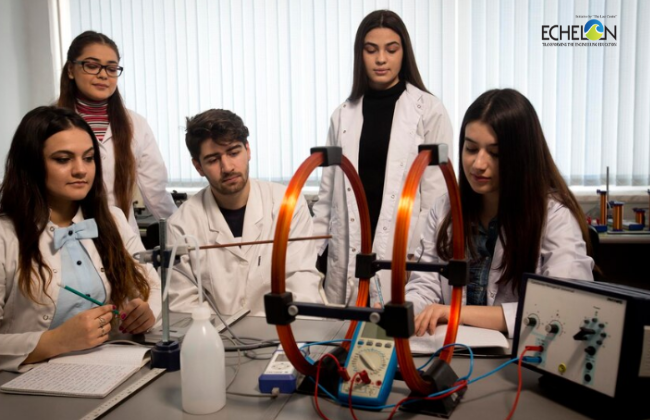
Theory alone is insufficient. We have invested in state-of-the-art labs that serve as innovation playgrounds. Here, students don’t just read about robots; they program collaborative robotic arms. They don’t just study AI; they train machine learning models to solve real-world engineering problems. Our project-based learning model encourages students to work on capstone projects that involve designing automated systems or developing AI-powered solutions, bridging the gap between academic concepts and industrial applications.
Fostering a Mindset of Continuous Learning:
The field of AI and automation evolves at a breakneck pace. Therefore, we instill a culture of continuous learning. Through workshops, expert seminars from industry leaders, and access to online learning platforms, we encourage our students to stay perpetually curious and constantly update their skill sets.
The Future is a Collaborative Endeavor
The integration of AI, robotics, and automation into engineering is not a distant dream. It is the present reality, and its influence will only grow. The engineers who will thrive are those who embrace this change, who are comfortable working alongside intelligent systems, and who can apply their human ingenuity to guide technological progress.
The mission of Echelon Institute of Technology, Faridabad is to mold these engineers. We are committed to providing an education that is rigorous, relevant, and responsive to the world’s needs. We are building a community of learners and innovators who will not just adapt to the future but will actively design it.
The future of engineering is intelligent, automated, and incredibly exciting. And it starts right here, in our classrooms and labs.
